Practise Irish out loud with Niamh
Niamh is a voice tutor for spoken Irish, and she speaks Connacht Irish. As a guest you get one conversation a day, free and without an account. When you are stuck you can use English or type, and afterwards you get a review, a level estimate and flashcards made from your own words. The Word Lab adds a drill for the mutations. Two honest limits: Tera's written Irish is less reliable than her French or Spanish, and the Word Lab's Irish words have no audio yet.
Maybe you learned Irish at school and it has gone quiet since. Maybe you are starting from nothing and want to say more than Dia duit. Either way, knowing words is only half of it. The other half is saying them out loud to someone who answers.
That is what Niamh is for. She is the Irish voice tutor in Testera's Language Lab, and you talk with her out loud, in a real conversation.
Who Niamh is
Niamh speaks Connacht Irish. If you learned Munster or Ulster Irish, you may notice some differences. Where Niamh says Cén chaoi a bhfuil tú? for ‘How are you?’, Munster says Conas atá tú? and Ulster says Cad é mar atá tú?
Speak at your own pace. A conversation lasts up to ten minutes, and you can end it whenever you like.
How to start
- Open Irish with Niamh.
- Press Start talking, and allow your microphone when your browser asks.
- Say Dia duit. She can hear you.
- When you want to stop, press End & review.
You do not need an account. As a guest you get one Language Lab conversation a day. Signing in is free, gives you three a day and keeps your flashcards with your account.
A few details: the allowance is shared across all the languages, not given per language, and it resets at midnight UTC. Guest allowances are counted per network, so people on one shared connection, such as a school's, share them.
When you are stuck
Everyone gets stuck, and that is fine. Two things help.
Use English for the missing word. English is allowed when you are stuck. Say the sentence with the one English word in it, and carry on.
Type instead of speaking. Under the conversation there is a box where you can type your line. It is there for noisy places, and for moments when speaking is hard.
What you and Niamh say also appears on screen as you talk, so you can read back anything you did not catch.
What you get afterwards
When you press End & review, Niamh writes you a short review:
- A level estimate from A1 to C2, with how confident it is. If you said only a few words, it asks you to talk a little longer instead of guessing.
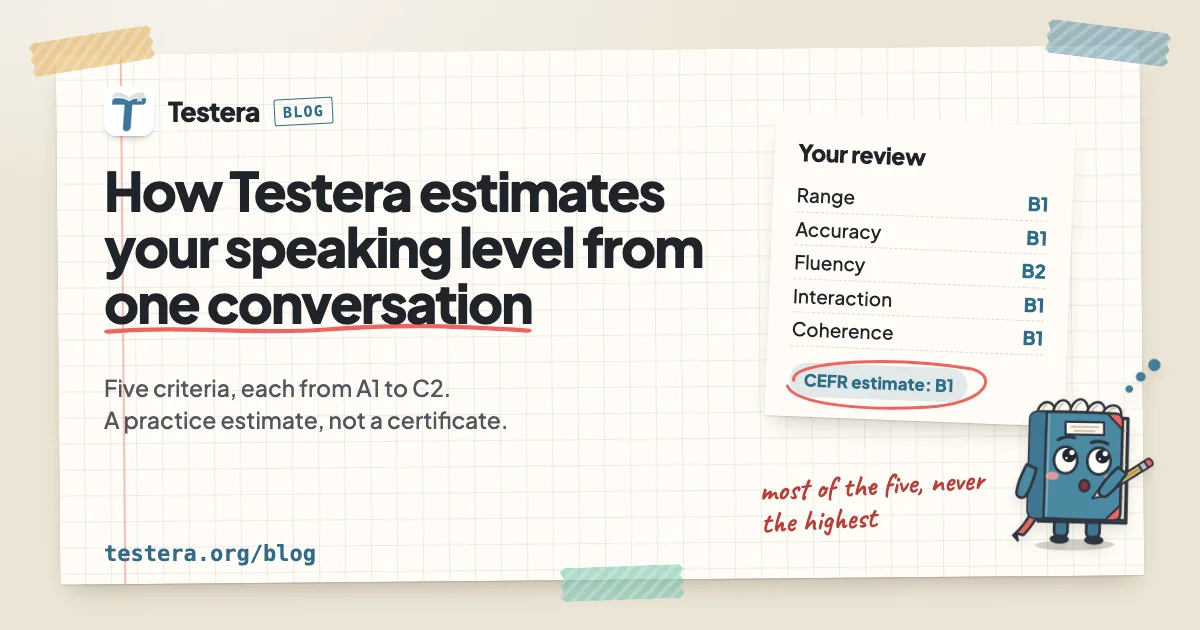
- Five criteria: range, accuracy, fluency, interaction and coherence, each with its own level.
- What worked: a few things you did well.
- Say it better: things you said, a more natural way to say them in Irish, and why.
- New cards: words from your conversation, saved as flashcards.
Two things to know about the level. Pronunciation is not rated, because the review works from a transcript, not from your voice. And it is a practice estimate from one conversation, not an official result or a certificate. How Testera estimates your speaking level explains the rest.
Your flashcards do not stay in a drawer, either. Niamh is given the cards you are due to review, so the words you are learning come back in your next conversation.
The mutations, one drill at a time
Irish changes the start of words. Bróg is a shoe, but my shoe is mo bhróg and our shoe is ár mbróg. These changes, séimhiú and urú, are where many learners trip.
The Word Lab has a drill for exactly this. Each question puts a word such as mo (my) or ár (our) in front of a noun, and you choose the right form. After every answer you see the rule, worked out from that noun's own forms. A round is ten questions.
The pattern it teaches:
- mo, do and a (my, your, his) add a séimhiú: mo bhróg.
- ár, bhur and a (our, your, their) add an urú: ár mbróg.
- a (her) leaves a consonant alone and puts h before a vowel: a hathair.
The Word Lab also teaches about sixty everyday Irish words and phrases, from greetings and food to the weather, as flip cards, a reading game and picture matching, and every noun comes with its gender. Learn a few there, then take them to Niamh and say them out loud.
Honest limits
Two things work less well in Irish than in some other languages on Testera, and it is better you know before you start.
Tera's written Irish is less reliable. Tera, the study coach in the corner of the page, can help with Irish in writing: vocabulary, grammar, short role-plays and corrections. Her written Irish is less reliable than her French or Spanish, so check anything important with a teacher. Her chat microphone understands English only, so type your Irish to her.
The Word Lab's Irish words have no audio yet. For now every Irish word there is shown in writing, which is why Irish has a reading game where other languages have a listening one. To hear Irish spoken, talk with Niamh.
The Irish page of the Word Lab also says how its words were checked, and which parts are still waiting for a native speaker's review. If you spot something to fix, tell us.
Broken Irish is fine
The Word Lab's Irish section quotes an old saying: Is fearr Gaeilge bhriste ná Béarla cliste. Broken Irish is better than clever English. It is a good rule for a first conversation with Niamh. Say what you can, use English for the gaps, and let the review help with the rest.
When you are ready, say Dia duit to Niamh.
Say Dia duit to Niamh
One conversation a day is free as a guest, up to ten minutes long, with a review and flashcards afterwards.
Talk with NiamhReply
A question, a correction, or something we got wrong? Reply by email to hello@testera.org.